For months we were told AI agents were going to buy on your customers' behalf: the user asks ChatGPT for a pair of trainers, the agent chooses, pays, and all you do is post the parcel. It is an appealing idea, and it already has protocols, announcements and acronyms. What it has far less of is WooCommerce shops where it actually happens.
This article separates what has happened from what is sold as if it had, as of 25 October 2026. With one warning: this changes every month, and where a source does not confirm something, I say so.
"Buy without leaving ChatGPT" did not turn out as expected
OpenAI launched Instant Checkout in September 2025, letting certain merchants sell inside the chat itself. In March 2026, CNBC reported that OpenAI was revamping its shopping experience after that feature struggled. The approach described by the sources I could consult is different: ChatGPT handles discovery (which product suits you) and the merchant closes the transaction.
Two caveats on what I could verify. First, I have not read an OpenAI statement that uses the word "retired"; my reading rests on press coverage and on the fact that its commerce documentation today talks about product feeds, the Agentic Commerce Protocol (ACP) and a checkout specification, without saying anything about Instant Checkout. Second, exact dates vary between outlets (some say 24 March), so I will not give you anything finer than "March 2026".
The practical point: your shop does not need to sell inside ChatGPT to show up in ChatGPT. And if someone offers you "the integration so people can buy inside the chat", ask which specific feature of which platform they are using, and since when.
Where ACP, UCP and Stripe stand on WooCommerce
Three acronyms get mixed up, so let us pull them apart.
ACP (Agentic Commerce Protocol) is the open protocol created by Stripe and OpenAI. Stripe's Agentic Commerce Suite is Stripe's product on top of it: you upload your catalogue and choose which agents to sell through. WooCommerce was a launch partner, but what its own pages say is more sober than the headlines. WooCommerce's announcement (11 December 2025) says it will roll out "in the coming months" and invites you to join a waitlist. On its agentic commerce page, checked in October 2026, Stripe's agentic checkout for WooCommerce is listed as not yet live: you can install the extension to prepare, and that is all.
UCP (Universal Commerce Protocol) is Google's. Its Merchant Center help page says UCP checkout is for selected merchants, with eligible products in the United States, Canada and Australia. It does not mention Spain or the UK. WooCommerce lists it as "coming soon".
MCP, by contrast, is real on WooCommerce today, but it solves a different problem: letting an assistant work inside your shop (look up orders, update products), not letting a customer buy. It is in developer preview. I cover it separately in another article.
An honest summary for a shop in Spain or the UK:
Piece | Status according to the official source |
|---|---|
Checkout inside ChatGPT | Revamped by OpenAI in March 2026 (per press) |
Stripe Agentic Commerce Suite on WooCommerce | Announced; agentic checkout is not live |
Google's UCP on WooCommerce | "Coming soon"; Google's checkout is limited to selected merchants in the US, Canada and Australia |
MCP on WooCommerce | Available, as a developer preview |
And the Claude agent for WooCommerce: what is it?
There is confusion here, so I will stick to what can be checked. On 2 September 2026, Anthropic published a blueprint for building commerce agents, with reference code for a shopping agent and a merchant agent. The repository is Apache 2.0 licensed and its README says it is a reference implementation that is not maintained and does not accept contributions.
On 16 September, the WooCommerce team published its adaptation in its agentic-tools repository. A shopper asks for products, the assistant builds a basket and sends it to the normal WooCommerce checkout; the assistant neither takes payment nor creates orders. On the merchant side it answers questions about sales and stock, and proposes changes that wait for someone to click "Approve".
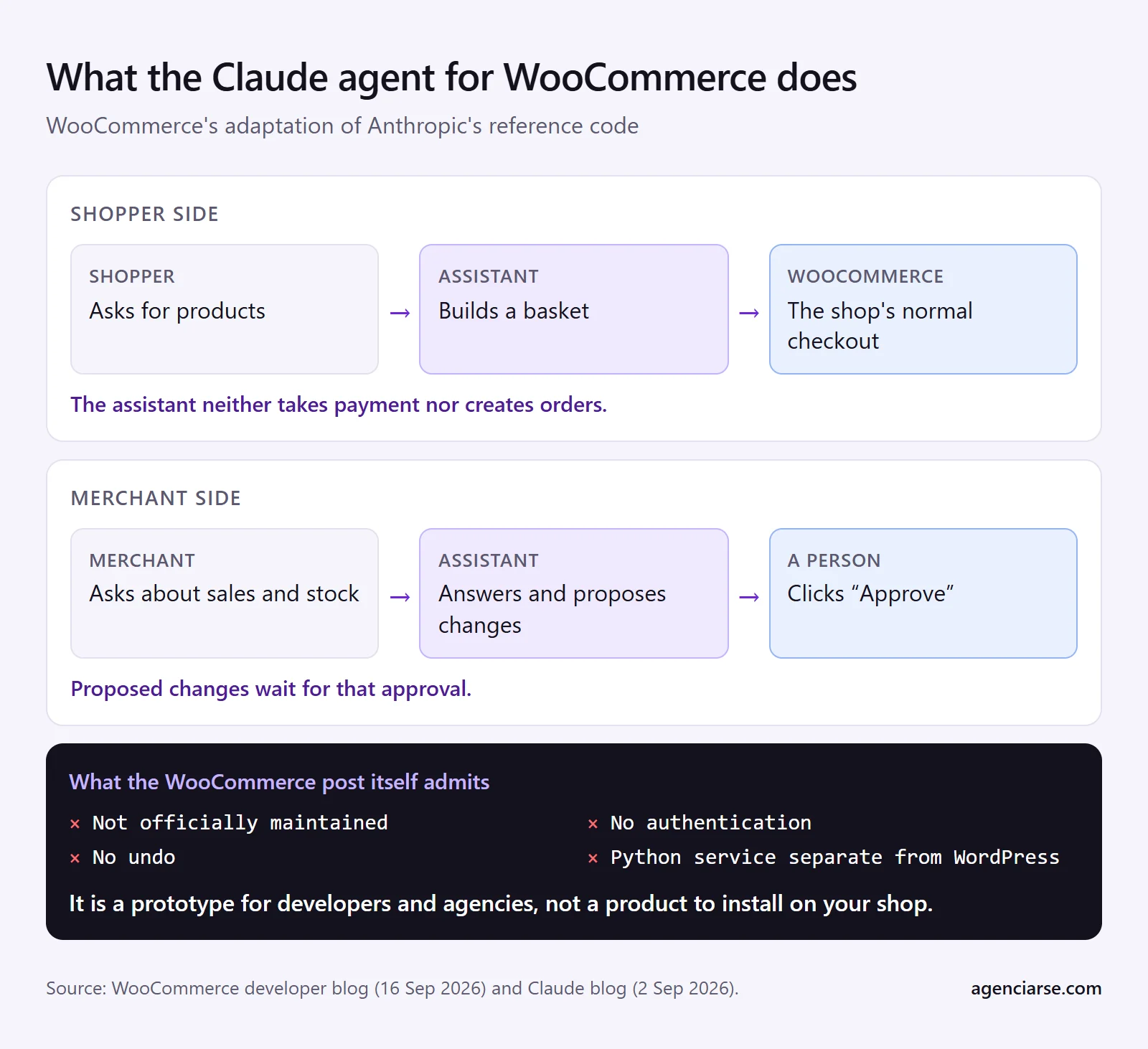
What matters is what the post itself admits. In summary: it is built "for experimentation and growth" and "not maintained within official capacity", it has no authentication (anyone who can reach the services can use them), no undo, and it is a self-hosted Python service running beside WordPress. It is aimed, they say, at developers and agencies evaluating prototypes. It is not a product to install on your shop tomorrow, and anyone offering it to you as one is selling you something else.
AI bots are already visiting your shop (and it is not what it seems)
While the protocols mature, something more tangible is happening: AI bots are visiting your site. It helps to tell three types apart, according to OpenAI's documentation:
- OAI-SearchBot: crawls so your site can appear in ChatGPT search. Controlled with
robots.txt. - GPTBot: crawls content that may be used to train models. Also controlled with
robots.txt. - ChatGPT-User: visits pages when a user asks it to in a conversation. OpenAI says it is not used to crawl the web automatically and that, since a user triggers it, "robots.txt rules may not apply".
Perplexity makes the same split: PerplexityBot (to appear in results) and Perplexity-User, which, being triggered by a person, generally ignores robots.txt.
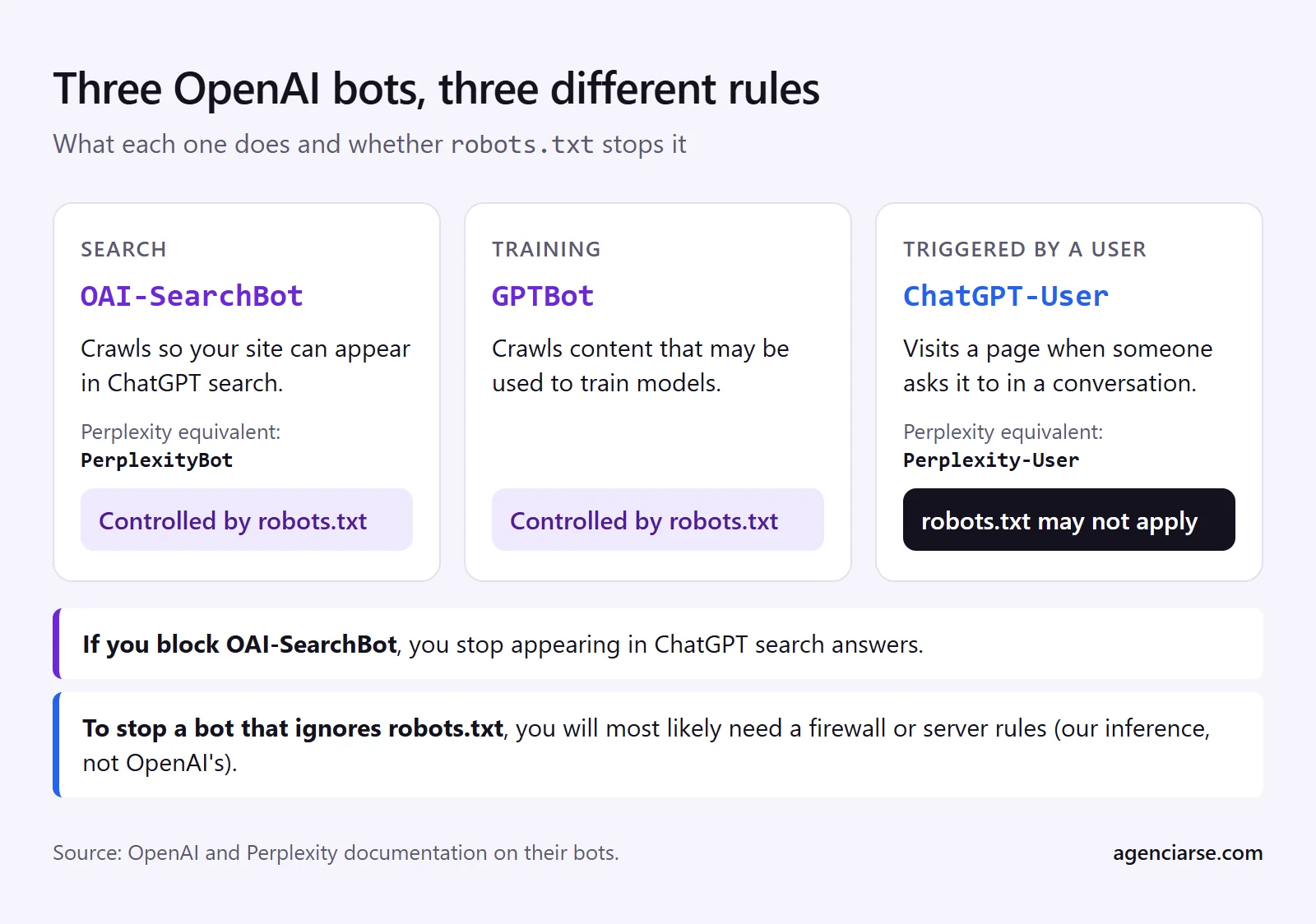
Two consequences. First: blocking everything "just in case" has a cost, because if you block OAI-SearchBot you stop appearing in ChatGPT's search answers. Second: if you want to stop a bot that ignores robots.txt, robots.txt is not enough; that is done with a firewall or server rules (this last part is my own deduction, not something OpenAI says).
And are my statistics getting polluted?
This is the most repeated claim and the least solid. I have found vendor guides saying that bot sessions distort metrics such as conversion rate, and others that disagree on whether Google Analytics 4's bot filter catches them. These are claims from companies that sell measurement tools; I have not found a primary Google source that quantifies it, and the guides I reviewed are mostly about Shopify, not WooCommerce.
What you can do without taking anyone's word for it:
- Look at your server logs (or ask your host). They show who requests what, with its user agent, including bots that do not run JavaScript and therefore never appear in Analytics at all.
- Check the IP addresses. OpenAI publishes the ranges for OAI-SearchBot, GPTBot and ChatGPT-User, and Perplexity publishes its own. A lot of traffic claiming to be an AI bot is not.
- Compare real orders with sessions. Bots rarely buy: if revenue is steady and sessions are climbing, suspect noise before celebrating.
- Create your own channel in GA4 for traffic arriving from chatgpt.com, perplexity and similar. Otherwise it ends up lumped into "Direct" or "Referral".
What to do in your shop today
None of this requires waiting for the protocols to settle. And almost all of it helps with plain old Google too.
Clean product data. Every route (feed, protocol, search engine) starts from the same material: a clear title, a useful description, price, availability, correct variations, images. If your catalogue has empty product pages or untouched supplier text, no protocol will fix that.
Structured data. Google distinguishes between product snippets and merchant listings (for pages where you can buy) and recommends combining them with a Merchant Center feed so it can verify the data. If you use the Google for WooCommerce extension, it syncs your catalogue to Merchant Center, which is the foundation WooCommerce mentions for being ready for UCP. Validate with the Rich Results Test.
A feed to OpenAI, with caution. OpenAI's commerce documentation describes uploading a feed over SFTP or an API. I could not confirm which merchants and countries it is open to, so do not treat it as a sure route for a shop in Spain or the UK without checking.
A considered robots.txt policy. Decide which bots you want to see you (search ones, say) and which not (training ones, say). And do not block out of panic.
An assistant on your own site. It is the least glamorous option and the most controllable: a chatbot that answers with the information from your shop (delivery, sizes, returns) and hands over to a person when needed. It does not depend on any outside agent deciding to cite you. At AGENCIA RSE we build it as a chatbot for WordPress; the underlying principle is the same as above: it should be clear what data it uses, and it should escalate to a human.
How to read the promises
When you hear "your shop, ready to sell to AI agents", three questions are enough: which specific agent? In which countries is it live? Which official document confirms it? If there is no answer to all three, it is marketing. What pays off verifiably today is the dull stuff: a well-written catalogue, well-structured data and a website that does not hide its information.
If you spot any outdated information, let us know and we will correct it. This area changes every few weeks.