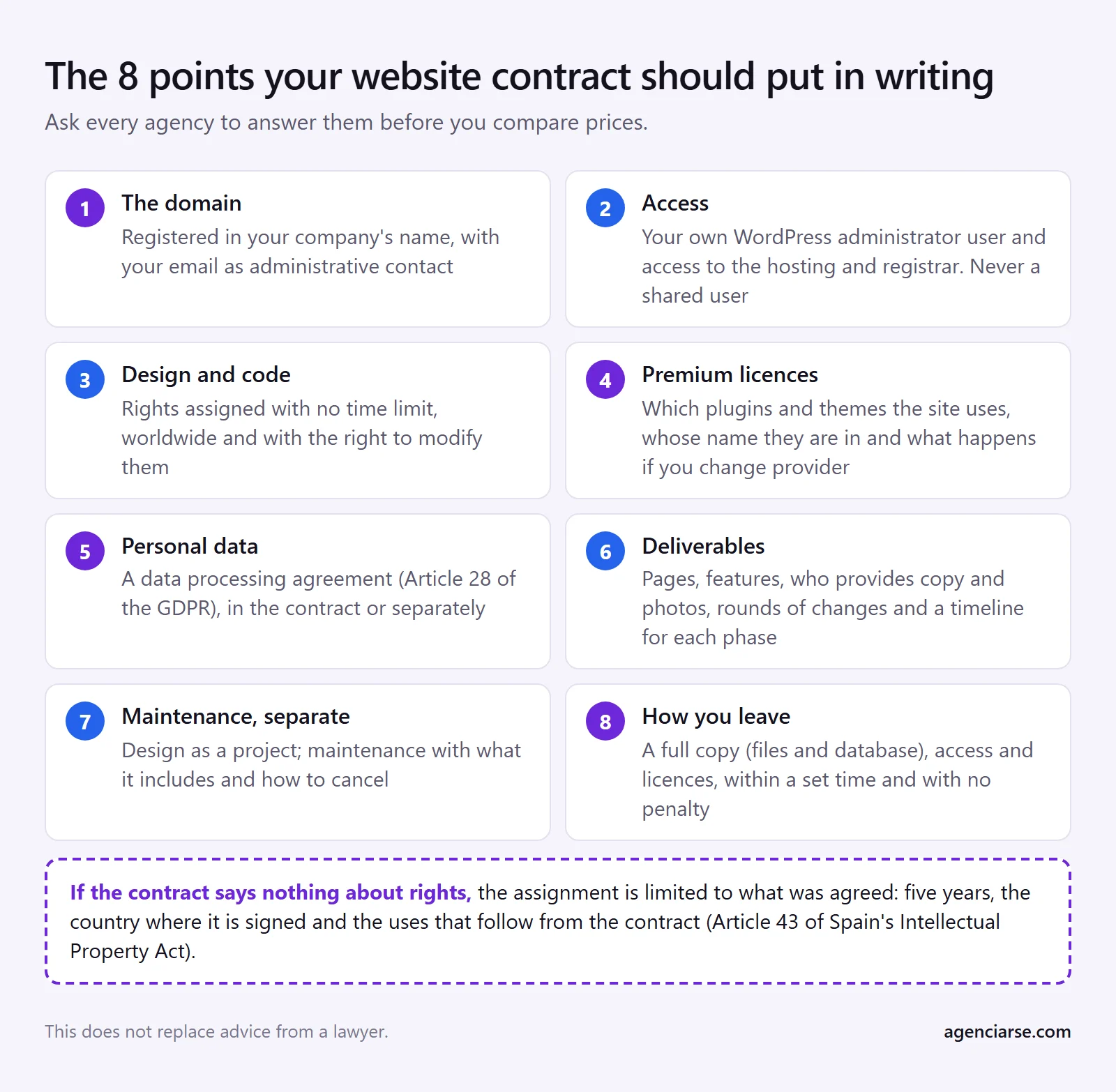
When you compare agencies to build your website, almost everyone looks at price, timeline and portfolio. What really decides whether, three years from now, you can change provider without losing anything lies elsewhere: in what the contract or quote puts in writing. If you are commissioning WordPress web design, these are the eight points worth checking before you sign, with what each should say and why.
This is not legal advice. If the project is large or you have doubts about a specific clause, have a lawyer read it. But with this list you will know what to ask.
1. The domain, in your name
The domain (yourcompany.com or yourcompany.es) has a holder, and that holder is the one in control. For .es domains, a change of holder must be started by the holder, the administrative contact or the registrar agent, as Dominios.es explains. If the agency registered it in its own name, changing it will depend on their cooperation.
One sentence in the contract is enough: the domain is registered (or already is) in your company's name, with your email as administrative contact. The agency can manage it, but should not be the holder.
2. Access, handed over and in your name
There are four keys: the domain registrar, the hosting, the WordPress administrator and email. Plus the third-party accounts that depend on the site: Google Search Console, Analytics, the payment gateway.
At the end you should receive your own administrator user in WordPress and access to the hosting and registrar. It is also fine for the accounts to be in your name with the agency as a guest. What does not work is a user shared with the agency: the day they change the password, you are locked out.
3. Who can use the design and the code
This is the most forgotten clause. In Spain, Article 43 of the Intellectual Property Act says an assignment of rights is limited to what has been expressly agreed; if no term is stated, it is taken to be five years; if no territory is stated, the country where it is signed; and if the uses are not specified, only those that necessarily follow from the contract. In other words, if the contract says nothing about rights, what you take away may be less than you think.
So it has to say something. The usual arrangement is that you are assigned the exploitation rights to the design, copy and code made for you, with no time limit, worldwide, and with the right to modify them and have another provider make changes. It is reasonable for the agency to keep the right to show the work in its portfolio and to reuse its generic pieces (for example, a code snippet it uses in many projects), as long as you can keep using them on your site.
4. Plugin and theme licences
WordPress and most plugins are free software under the GPL licence: the code can be used and modified. But premium versions (Elementor Pro, Bricks, WooCommerce extensions…) sell a licence that gives updates and support. If the licence belongs to the agency and you stop working with them, the plugin will keep working, but without security updates.
That is why the contract should list which premium plugins and themes the site uses, whose name each licence is in, and what happens to it if you change provider. Cleanest option: licences in your name, or a commitment to transfer them.
5. Personal data
If the site has forms, a shop or a customer area, it stores personal data. An agency that accesses it to build or maintain the site acts as a data processor, and Article 28 of the GDPR requires a contract governing it: what data it processes, for what, with which security measures and what it does with the data at the end.
Ask about that data processing agreement, which can sit in the same contract or separately. If the agency does not know what you mean, that is a sign.
6. What is delivered, in detail
"A corporate website" is not a deliverable. A good quote states how many pages, which features (forms, bookings, shop, languages), who provides the copy and photos, how many rounds of changes are included and what happens if you ask for something outside the agreement. And it puts a timeline on each phase.
In our projects, for example, the quote is fixed and in writing: if something changes, it is quoted before doing it, not after. With a closed list, nobody argues afterwards about what was included.
7. Maintenance, separate from design
Building the site and maintaining it are two different jobs. The first one ends; the second is monthly (updates, backups, monitoring). Bundling them into one fee makes it hard to know what you are paying for and almost impossible to change one without the other.
The reasonable arrangement is that design is paid as a project and maintenance, if you take it, is separate, with what it includes and how to cancel. Be wary of a "free" or very cheap website tied to a long minimum term: the real price is usually in the fee.
8. How you leave
It is the clause nobody wants to write, and the most useful one. If the relationship ends, what do they hand over? Within what time? And who pays for the migration?
A good contract answers all three: a complete copy of the site (files and database), the access and the licences, within a specific time and with no penalty for taking it. If the hosting belongs to the agency, they should help you move it or, at least, not get in the way.

What now
Take these eight points to the meeting and ask every agency to answer them in writing before you compare prices. It is the quickest way to find out who leaves you free and who does not. If an agency answers all of it well, the rest (design, timeline, price) can be negotiated.
If you already have a site and your current provider will not give you access, that is a different problem, and it goes through WordPress migration. And if you want to see how we approach it, our custom WordPress web design page explains what you take away at the end.
Reviewed on 27 November 2026. This article does not replace advice from a lawyer.